
SEBRI
The five states of AI adoption
Adoption is not a rollout. It's five things that have to be true inside one person before they'll actually use the thing.
It's a diagnosis, not a to-do list.
Most adoption frameworks give you a sequence of activities: communicate, train, support, measure. You can complete every one of them and change nothing, because the activities were never the problem.
SEBRI™ describes five states — things that are either true or not true inside a specific person.
You find the first one that's missing and you fix that one.
Safety
"I won't get in trouble for trying it."
Not data security. Permission. Missing when your most conscientious people are silent, or when usage has quietly moved onto personal accounts.
S
Example
"Someone like me has gotten a real result."
A peer. Not an executive, not the AI champion. Missing when they can name the tool but not a person.
E
Benefit
"I won't get in trouble for trying it."
Not data security. Permission. Missing when your most conscientious people are silent, or when usage has quietly moved onto personal accounts.
B
Repetition
"I've used it on my own real work, more than once."
Missing when people are trained, licensed and not using it — able to discuss AI in the abstract with no story from their own week
R
Identity
“I know what I bring that the tool doesn’t".”
Missing when your most experienced people are the most resistant. Sarcasm. Cataloguing the tool’s errors. Compliance to the letter and not one task further.
I
Identity comes last for a reason.
You cannot resolve someone's identity question in the abstract. Only after they've used the thing enough to know what it does and doesn't take from them.
Reassurance before repetition is noise.
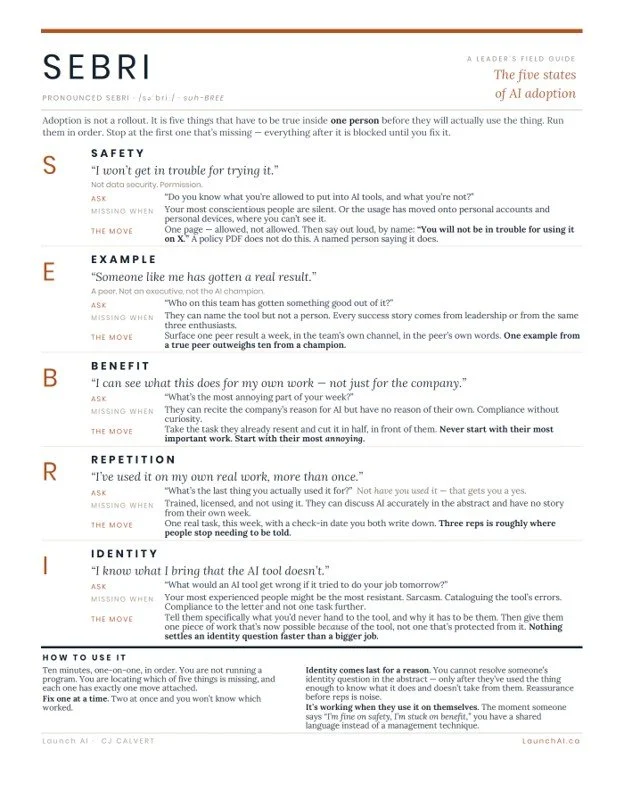
The Manager’s Field Guide
Each state has a question to ask, the signals that tell you it's missing, and exactly one move attached.
Ten minutes, one-on-one, in order.